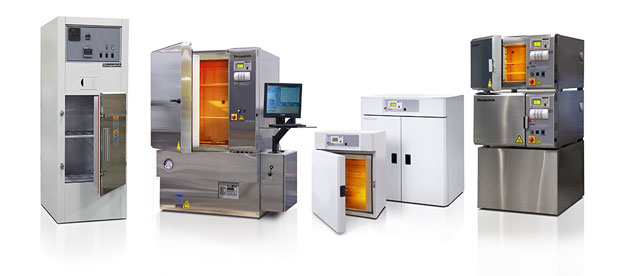
Lab ovens are standard equipment in many labs. They provide uniform temperature and precise temperature control in medical, forensic, application-based, pharmaceutical, electronics, research laboratory, and material processing situations. Lab oven temperatures range from ambient to over 300°C (572°F). Often, new lab ovens pay for themselves quickly while providing customers superior-quality products.
Critical considerations when choosing a lab oven are type, application, size, volume, temperature requirements, heating uniformity, airflow, and cleaning and maintenance. Additional considerations are energy consumption, efficiency, and budget. Several oven types fit into this product category. They include digital, analog, heavy-duty, high temperature, vacuum, forced-air convection, and gravity-convection ovens.
Below are the top six laboratory oven suppliers in the United States.
1. Despatch Industrial Ovens

Despatch is an international supplier of lab ovens. Known as a global leader in this product category, the company features a full line of lab ovens that include the
- LBB Laboratory Ovens
- LAC High Performance Laboratory Ovens
- LCC/LCD Clean Process Lab Oven
- LFC Class A Laboratory Oven
- Qmax Laboratory Oven for Testing
- RBC Laboratory Oven for Burn-in
These lab ovens provide highly reliable operation, superior uniformity, maximum versatility, and consistent results. They feature sturdy, welded, double-wall construction, thick glass fiber insulation, and heavy-duty door gaskets and carry a five-year warranty on their heating elements.
For flammable solvent applications that involve flammable solvents, the company offers Class A lab ovens with a pressure relief panel, purge timer, and exhaust fan to meet NFPA 86 requirements.
Headquarters:
8860 207th Street
Lakeville, MN 55044
Website: ww.despatch.com
Phone: 952-469-5424
Toll-free: 1-800-726-0110
2. Grieve

Grieve Corporation has a history of producing long-lasting, high-quality ovens for a wide variety of industries. The company has been making ovens since 1943. Grieve produces low-cost, fully equipped lab ovens for drying, baking, annealing, conditioning, sterilizing, evaporating, dehydrating, and general laboratory work.
Heat in Grieve’s ovens comes from the bottom up through the oven chamber by natural convection. It exits through vents in the top of the oven. The maximum temperature for Grieve lab ovens is 518ºF (270ºC). Grieve Corporation also produces custom lab ovens tailored to specific worksites and requirements.
Headquarters:
500 Hart Road
Round Lake, IL 60073-2898
Website: www.grievecorp.com
Phone: 847-546-8225
3. Quincy Lab

Quincy Lab is known for its experience and expertise in crafting dependable lab ovens. It manufactures all its ovens in-house using state-of-the-art CNC equipment and software solutions. Quincy manufactures both analog and digital lab ovens as well as low-temperature lab ovens. Plus, it manufactures lab oven replacement parts and optional equipment.
Quincy’s GCE (Digital Gravity Convection) and AFE (Digital Air Forced) series lab ovens meet the needs of industry, research organizations, and schools. Its lab ovens are ideal for a wide variety of applications, including part drying, baking, curing, sterilizing, evaporating, heat treating, annealing, and testing.
Headquarters:
109 Shore Drive
Burr Ridge, IL 60527
Website: quincylab.com
Phone: 1-800-482-4328
4. Sheldon Manufacturing

Sheldon Manufacturing is an ISO 9001:2015 certified manufacturer of innovative, high-quality constant-temperature equipment. The company’s Shel Lab Oven series products provide fast heating, temperature recovery, uniformity for drying, baking, and curing needs.
The series includes vacuum, gravity convection, high-performance, and forced-air lab ovens. Shel’s cleanroom ovens have all the critical features these types of ovens need, such as a fully welded stainless-steel interior, two adjustable perforated stainless-steel shelves, rapid heat recovery, and two separate LED digital displays for time and temperature.
The displays offer both setpoint and up-to-the-second readings.
Headquarters:
300 N. 26th Avenue
Cornelius, OR 97113
Website: www.sheldonmanufacturing.com
Phone: 503-640-3000
5. Yamato Scientific America

Yamato Scientific America is located in San Jose, CA. Founded in 1989, it provides general laboratory products to the US marketplace. It offers an extensive line of reliable lab ovens, including natural convection, forced convection, fine, vacuum, and inert gas laboratory ovens.
Its laboratory cleanroom ovens include a forced-convection Class 100 unit and a large-capacity forced-convection Class 100 oven. It also offers natural convection and forced convection incubators as well as laboratory furniture, including fume hoods, clean benches, and fume hood exhaust gas washers. Yamato Scientific America is a wholly-owned subsidiary of Yamato Scientific.
Headquarters:
2040 Corporate Court
San Jose, CA 95131
Website: www.yamato-usa.com
Phone: 1-800-292-6286
6. Thermo Scientific

Thermo Scientific is an industry-leading brand of Thermo Fisher Scientific. Thermo Scientific provides heating equipment designed to ensure exceptional performance, safety, efficiency, and consistent results. The US-based company’s full line of lab-oriented products includes heating, drying, and vacuum ovens, lab furnaces, lab box furnaces, and lab tube furnaces.
Thermo Scientific also offers wireless monitoring solutions for heating equipment, hybridization ovens, lab centrifuges, lab shakers, and lab oven and furnace accessories. The company designs its ovens and furnaces to deliver consistent results across all applications—from drying delicate samples or everyday labware to performing high-quality tests in manufacturing processes.
Headquarters:
168 Third Avenue
Waltham, MA USA 02451
Website: www.thermofisher.com
Phone: 781-622-1000
How to Compare Laboratory Oven Suppliers
Choosing the right supplier takes more than checking maximum temperature or chamber size. Most labs compare suppliers across measurable criteria that affect consistency and safety, and long-term use.
Uniformity and Temperature Control
Uniformity is one of the most important performance indicators. Look for data showing how much the temperature varies across the chamber (often written as ±°C). Also confirm how the supplier tests uniformity, since methods differ between manufacturers.
Temperature Recovery After Door Openings
Some processes involve frequent access to samples. Ovens with fast recovery return to the setpoint sooner, which helps maintain reliable results. Ask for typical recovery times at working temperatures instead of generic claims.
Clean-Process Construction
Welded stainless-steel interiors, smooth seams, and optional HEPA filtration reduce contamination risk. Labs working in electronics, optics, or medical manufacturing typically prioritize these features because they directly influence product quality.
Safety Configurations
Processes that involve solvents or volatiles generally require Class A features. These include a purge timer, exhaust fan, and a pressure-relief panel to help meet NFPA 86 requirements. Not all suppliers integrate these features in the same way, so documentation must be checked.
Airflow Pattern and Its Effect on Samples
Airflow type influences uniformity and drying consistency. Forced-convection ovens circulate heated air for more stable results, while gravity-convection models move air without a fan. Evaluating airflow helps avoid poor performance with larger or more sensitive loads.
Service, Parts, and Documentation
Reliable manuals, bulletins, and a clear parts program make maintenance easier. Some suppliers stock common components domestically to reduce downtime. Consider availability of service support, not just initial purchase price.
| Criterion | What to Review | Why It Counts |
|---|---|---|
| Uniformity (±°C) | Ask for documented uniformity across multiple test points at working temperature. | Shows how evenly the chamber heats. Tighter ranges support consistent results and reduce repeat runs. |
| Temperature Recovery | Typical recovery time after a door opening, measured at setpoint. | Slow recovery affects drying time, curing time, and overall process stability. |
| Airflow Type | Forced convection vs gravity convection; fan placement; airflow direction. | Airflow influences uniformity, drying rate, and sample placement flexibility. |
| Clean-Process Features | Welded stainless interior, smooth seams, HEPA options, low-particle components. | Important for electronics, optics, medical, and other contamination-sensitive work. |
| Safety Configuration | Availability of Class A models, purge timer, exhaust fan, and relief panel. | Required for processes with solvents or vapors to help meet NFPA 86 expectations. |
| Temperature Range & Stability | Maximum temperature, control accuracy, and stability at load. | Ensures the oven supports current and future processes without drifting. |
| Construction Quality | Insulation thickness, door seal design, mechanical rigidity, materials. | Durable construction supports stable uniformity and reduces heat loss. |
| Controls & Interface | Controller type, display readability, alarms, data handling, setpoint accuracy. | Clear controls reduce operator error and support repeatable cycle settings. |
| Documentation | Manuals, technical bulletins, installation guides, maintenance instructions. | Quality documentation cuts downtime and helps facilities meet internal compliance needs. |
| Parts & Service Availability | Stocked parts, typical ship times, service channels, warranty details. | Readily available support shortens downtime and makes long-term ownership more predictable. |
| Cleanroom Compatibility | Particle-minimized components, welded interiors, optional filtration. | Needed when integrating an oven into controlled environments. |
| Lead Time & Scalability | Typical build times and availability of multiple model sizes. | Helps schedule equipment changes and expansions without disrupting lab operations. |
Common Selection Mistakes and How to Avoid Them
Even experienced buyers can run into issues when specifying a lab oven. A few recurring problems stand out across research and manufacturing environments.
Choosing the Wrong Airflow Type
Gravity-convection models work well for simple drying or warming tasks but can struggle with temperature consistency when shelves are full. Forced-convection ovens maintain more stable conditions, especially during heavier workloads.
Underestimating Chamber Volume
It’s common to size an oven for the samples alone and forget about airflow gaps. Crowded shelves restrict air movement, leading to uneven heating. Selecting a slightly larger chamber often results in faster cycles and better uniformity.
Overlooking Solvent-Related Safety Needs
Some applications require Class A features to handle vapors safely. Without the correct configuration, processes may fall short of facility requirements or safety codes.
Not Accounting for Cleanroom Needs
Cleanroom-compatible ovens have specific construction features, such as welded stainless interiors and HEPA options. Standard models may introduce particles or micro-contamination unless upgraded.
Assuming All Ovens Recover Temperature at the Same Speed
Recovery time varies widely between models. For labs that open the door often, slower recovery can affect data quality and extend total cycle time.
What are Ovens Used for in a Lab?
Lab ovens are ideal for a wide range of laboratory processing applications. Typical applications include removing moisture from samples in environmental, biological, and clinical settings, eliminating bacteria or microorganisms from electronic or medical products, strengthening metal or glass, and evaporating excess solvents, such as water, from a solution to produce a concentrated solution or measure their melting point.
Additional lab oven applications include drying glassware, sample drying, melting, chemical reactions, and die-bonding, a manufacturing process for attaching semiconductor die to its packaging or some substrate. Other applications include space systems because of the oven’s ability to improve bond strength between materials, sterilizing equipment used in operations, and developing fingerprints in forensics applications.
Researchers expect the global lab oven market to grow at a CAGR of 4.6% from 2019 to 2027. Driving the demand for lab ovens are blood banks and food testing facilities.
Frequently Asked Questions About Laboratory Ovens
What is the difference between forced convection and gravity convection ovens?
Forced-convection ovens use a fan to circulate air, which helps maintain stable temperatures and usually means faster drying. Gravity-convection ovens rely on natural air movement, making them suitable for simple tasks where minor variations are acceptable.
How do I know if I need a Class A oven?
Class A models are typically used when a process involves solvents or vapors that need controlled removal. They include features such as a purge timer, relief panel, and exhaust fan to help meet NFPA 86 requirements.
Can a lab oven be used in a cleanroom?
Yes, but it must be designed for that environment. Cleanroom-compatible ovens usually include welded stainless interiors, low-particle components, and optional HEPA filtration to reduce contamination.
What uniformity range should I look for?
Uniformity is often expressed as a ±°C value measured across multiple points in the chamber. Tighter ranges offer more consistent results, which is especially important when it comes to sensitive research, testing, and manufacturing tasks.
How do I determine the right chamber size for my workload?
Consider the size of your samples, the number of shelves needed, and the airflow gaps required for even heating. Selecting a chamber with extra space will likely improve uniformity and reduce cycle times.